Golf course superintendents and turf managers in the UK, Ireland, Australia, and parts of Northern Europe have been dealing with the same problem for decades - earthworm casts on putting greens and fairways. Not the earthworms themselves, but what they leave behind. A heavily cast surface becomes uneven, slippery when wet, and aesthetically unacceptable for premium turf. On a competition putting green, the difference between a well-managed surface and a cast-covered one is immediately obvious.
For a long time, carbendazim was the go-to solution in Europe. It worked. Then the EU withdrew approval in 2007, and turf managers were left looking for alternatives that actually controlled casting without creating a new set of regulatory or environmental headaches.
Tea saponin - specifically the extract derived from camellia seed meal - has moved from a fringe option to a genuinely viable tool in this context. It's not a perfect replacement for every situation, but for procurement managers sourcing raw material for turf products, and for formulators developing alternatives to withdrawn synthetic actives, it's worth understanding what the data actually says.

Why Earthworm Casts Are a Turf Management Problem
The earthworms themselves aren't the target. They aerate soil, improve drainage, and break down organic matter - most agronomists would consider them beneficial at moderate population densities. The problem is specifically cast production on fine turf surfaces, where even modest worm activity creates raised mounds that interfere with play, reduce mowing quality, and provide a seedbed for weed establishment.
In temperate, moist climates - which describes most of the UK, Ireland, western France, New Zealand, and parts of the Pacific Northwest - earthworm populations on intensively managed turf can reach extremely high densities. Putting greens built on native soil with organic matter accumulation are particularly susceptible. The species most responsible for surface casting in European turf are Aporrectodea longa and Lumbricus terrestris, both deep-burrowing anecic species that deposit casts directly at the surface.
Turf managers have tried acidifying fertilizers, topdressing with angular sand, clipping removal, and various cultural approaches with mixed results. None of them reliably suppress casting to acceptable levels on its own. That's the gap tea saponin fills - not as a soil amendment, but as a contact irritant that drives earthworms to the surface or suppresses their activity temporarily.
How Tea Saponin Works on Earthworms
The mechanism isn't complicated. Earthworms breathe and maintain moisture balance through their skin, which is coated with mucus. Tea saponin, as a natural surfactant (triterpenoid glycoside structure), disrupts this mucous layer on contact. The earthworms respond by surfacing - moving away from the treated zone - and in higher concentrations or with prolonged exposure, desiccate and die.
This is the same expellant principle that British greenkeepers were using in the 1890s with mowrah meal, a saponin-containing product from Bassia latifolia seeds. The chemistry is different but the mode of action is identical, which is why the historical record of saponin use in turf goes back further than most people realize.
University of Kentucky trials, published in Pest Management Science, produced results that are genuinely difficult to ignore. A single application of tea seed meal reduced earthworm casting by over 95% for at least five weeks on a pushup-style putting green. A separate October trial showed 98% cast reduction after two days, tapering to 83% after 30 days. These aren't controlled lab numbers - they're field trials on actively managed golf course turf.
The key detail from those trials: the active component was confirmed to be the natural triterpene saponins in the tea seed, not any other fraction of the meal. This matters for formulation - it means that tea saponin extract (rather than raw tea seed meal) can be used in liquid formulations with predictable and consistent activity.
Powder, Meal, or Liquid Extract?
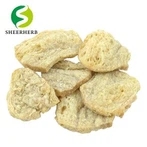
Tea seed meal (the raw by-product of camellia seed oil extraction, containing 12–18% saponin) is the cheapest form and has the most field data behind it for turf use. Some of the USGA-cited trials used granular meal applied at 200–400 kg/ha. It also has secondary value as a slow-release organic fertilizer - nitrogen content from the residual protein fraction provides a minor fertility boost. The limitation is inconsistency: saponin content in raw meal varies by origin, harvest timing, and processing method, which makes dose standardization difficult for a registered product.
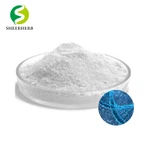
Tea saponin powder (standardized extract, typically 60% or 90% purity) solves the standardization problem. It allows formulators to build products with a defined active content per application, which matters for any product moving toward regulatory registration. Liquid formulations using dissolved tea saponin powder, applied and then watered deeply into the soil profile, have shown comparable results to meal applications in field conditions. Dora Agri, one of the more active suppliers in this space, has reported effective use at 500–1200× dilution rates on turf in Australia.
Liquid tea saponin (typically 35% concentration) is the most straightforward for spray application but tends to be less stable during storage and transport compared to powder. For ambient-temperature shipping across long distances, powder format is generally preferable for raw material procurement.
For product developers building a turf management product targeting the UK/Ireland/European market, the most defensible starting point is a standardized 60–90% powder, formulated into a liquid concentrate that turf managers can apply with existing spray equipment and water in. That mirrors how Early Bird Natural Organic Fertilizer worked - the product that effectively created the commercial market for saponin-based turf management before it was discontinued.
The Regulatory Situation: Honest Assessment
In the US, tea saponin-based turf products are currently sold as fertilizers or soil amendments rather than pesticides - which means no EPA registration is required, but it also means no pest control claims can be made on the label. Pennsylvania State University's extension service explicitly notes this limitation. Turf managers use the products and understand the earthworm control benefit, but you won't find "controls earthworms" on the label of a US product.
In the UK and Ireland, the situation post-Brexit has evolved separately from EU pesticide regulation. Some saponin-based products are marketed with earthworm management language in these markets, though the regulatory pathway varies by product format and claim.
For EU markets, novel turf pesticide registrations face a long approval process under Regulation 1107/2009. The current status of tea saponin as an active substance for this use has not reached approval - meaning EU-registered pesticide products with earthworm control claims are not currently achievable with tea saponin as the declared active.
The practical implication for B2B buyers: if you're sourcing tea saponin for a turf product targeting Europe, the commercial route is currently through organic fertilizer or soil conditioner positioning, not registered biopesticide. That limits label claims but doesn't limit actual use or effectiveness. It's a positioning constraint, not an efficacy constraint.
What to Look for When Sourcing
A few things separate reliable tea saponin supply from unreliable:
Saponin content should be verified by HPLC, not UV spectrophotometry alone. UV methods can overstate saponin content by picking up other compounds. Ask specifically which method your supplier uses.
Solvent residue data matters if you're targeting organic certification pathways. Hot water extraction produces a cleaner profile than alcohol or hexane extraction; supercritical CO₂ extraction is the cleanest but adds cost. Know which process your raw material comes from.
Batch consistency is the practical test. Request COA data across three or more recent batches. A good supplier will show you real variation rather than suspiciously identical numbers.
Sheerherb (sheerherb-bio.com) is a China-based botanical extract manufacturer that supplies tea saponin powder to agrochemical and turf product developers. We carry 60% and 90% specifications, with HPLC-verified content and batch documentation available. If you're evaluating raw material sources or need samples to run your own trials, feel free to reach out at chriswang@sheerherb.com - we're fairly easy to work with on sample requests.