

Latest Products



Contact Us
- Room 1204, Vanke Huizhi Center, No. 56 Xifeng Road, Yanta District, Xi'an, Shaanxi, China.
- Chriswang@sheerherb.com
- +86 132 8987 3310
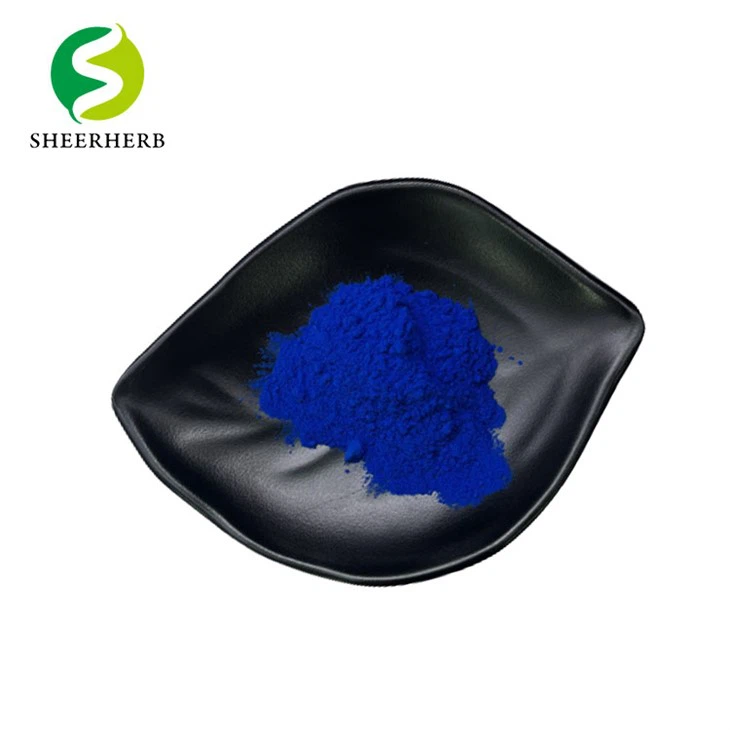
Phycocyanin Powder
Product name: Phycocyanin
Grade: Food/Drink/Cosmetic/Healthcare Grade
Cultivation method: Artificial planting
Appearance: Blue Fine powder
Sample: Free Sample
Solubility: Good Water Soluble
Shelf life: 2 Years
Packaging: 1kg/ bag, 10kg/ carton
Description
Products Description
What is Phycocyanin?
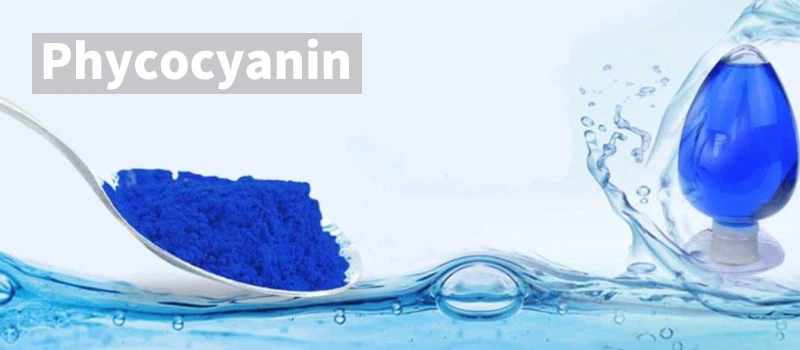
Phycocyanin is a dark blue powder isolated from spirulina. Mainly found in cyanobacteria, red algae and cryptophyta. Phycocyanin is also usually divided into C-phycocyanin and R-phycocyanin, the former mainly exists in cyanobacteria, the latter mainly exists in red algae, both of which are found in cryptophycobacteria. Its function is to absorb light (orange) energy and transmit light energy. It is not only a kind of protein, but also an excellent natural food coloring, and it is also a good health food.
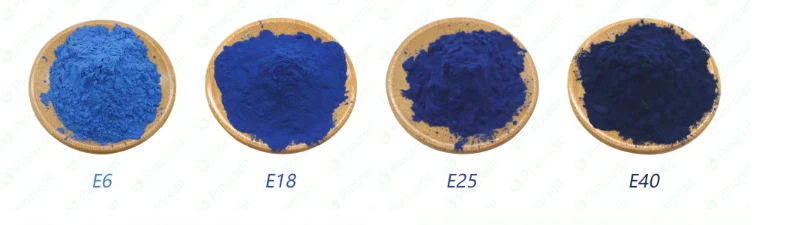
Popular Specifications of Blue Spirulina on the Market
|
Specifications |
E6 |
E18 |
E25 |
E40 oganic |
|
Protein assay |
15~20% |
35~40% |
55~60% |
80~85% |
|
Phycocyanin assay |
20~25% |
50~55% |
76% |
92% |
Products Specification
|
Item |
Specification | Result |
Test method |
|
Appearance |
Blue Fine Powder |
Conforms |
Visual |
|
Smell |
Characteristic |
Conforms |
Olfactory |
|
Impurity |
No Visible Impurity |
Conforms | Visual |
|
Particle Size |
≥95% through 80 mesh |
Conforms |
Screening |
|
Residue on lgnition |
≤5g/100g |
2.99g/100g |
3g/550℃/4hrs |
|
Loss on Drying |
≤8g/100g |
4.16g/100g |
3g/105℃/2hrs |
|
Total Protein Content |
≥15% |
18.54% |
Kjeldahl method |
|
Color Value |
≥E6 |
6.93 |
UV(E1%618nm in distilled water) |
|
Purity |
≥1.5 |
1.61 |
UV(A620nm/A280nm) |
| PH |
pH 5-7 |
Conforms |
1g in distilled water100ml |
|
Ingredients |
Phycocyanin(Spirulina extract)20%-25%,Maltodextrin 75%-80% |
||
|
Residue Analysis |
|||
|
Heavy Metals |
≤10mg/kg |
Conforms |
|
|
Lead(Pb) |
≤2.00mg/kg |
Conforms |
ICP-MS |
|
Arsenic(As) |
≤2.00mg/kg |
Conforms |
ICP-MS |
|
Cadmium(Cd) |
≤1.00mg/kg |
Conforms |
ICP-MS |
|
Mercury (Hg) |
≤0.5mg/kg |
Conforms |
ICP-MS |
| PHA(Ba P+CHR+BaA+BbFA) |
≤40μg/k |
Conforms |
GC-MS(BaP+CHR+BaA+BbFA) |
|
Benzo(a)pyrene |
≤5μg/kg |
Conforms |
GC-MS |
|
Microbiological Tests |
|||
|
Total Plate Count |
≤10000cfu/g |
500cfu/g |
AOAC 990.12 |
|
Total Yeast & Mold |
≤100cfu/g |
10cfu/g |
AOAC 997.02 |
|
Coli-group |
≤10cfu/g |
Conforms |
AOAC 997.02 |
|
E.Coli. |
Negative/10g |
Conforms |
AOAC 991.14 |
|
Salmonella |
Negative/10g |
Conforms |
AOAC 998.09 |
|
S.aureus |
Negative/10g |
Conforms |
AOAC 2003.07 |
| Aflatoxins(B1+B2+G1+G2) |
<20μg/kg |
Conforms |
HPLC(B1+B2+G1+G2) |
| Aflatoxin B1 |
<5μg/kg |
Conforms |
HPLC |
| Microcystins |
<1μg/kg |
Conforms |
HPLC |
Production Process
(1) Breaking the wall: The first step of extraction needs to open the cell wall of the algae. Common wall-breaking techniques can be divided into two categories, physical means such as high pressure, mechanical shear, freeze-thaw, hypotonicity, ultrasound and microwave assistance, etc., and chemical methods such as mixed reagents, enzymatic hydrolysis, acid hydrolysis, active agents, etc. In production application, the difficulty of equipment and process, as well as cost controllability must be considered first.
(2) Dissolution: Regardless of whether the raw material is dry powder or wet algae mud, it is necessary to dissolve phycocyanin into the water first. This step is usually performed together with the first step. For the stability of phycocyanin, it is necessary to control the water temperature and Involves the setting of parameters such as ion background and pH.
(3) Separation: After solid-liquid separation and slag removal, the phycocyanin dissolved in water is usually separated by salting out/protein isoelectric point flocculation to obtain crude products.
(4) Purification: The crude product needs to be further purified to remove impurity proteins and unnecessary various ions. It is applied to technical principles such as salt dissolution-salting out, filtration, osmosis-reverse osmosis, chromatography, etc. There are many technological innovations in this stage of purification. A lot of new equipment has been born, and because of the different requirements for product purity, the difference in process design in application will be very large.
(5) Preparation: Through the purification link, before the "high" purity product is supplied to the market, there is a preparation process, such as configuring a certain concentration of water or dry powder preparation, adjusting the pH, Treatments such as adding specific chemicals (such as sodium citrate) or microencapsulation.
Products Efficacy
● Food additives - pigments
Phycocyanin is a rare edible blue pigment in nature, and it is a gorgeous sapphire blue. The US FDA approved the application of phycocyanin in some foods in 2013/2014, including beverages, cheese, ice cream, candy, chewing gum, yogurt, pudding and other common foods. The national standard for additive algae blue will also be implemented in March 2021 (GB 1886.309-2020), so blue foods have become more and more common in recent years.

● Cosmetics
The application of phycocyanin in cosmetics is mainly in the form of pigments. Common products include moisturizer, whitening cream, soap, eyeliner, lipstick and so on.

● Biological efficacy
The research on the health effects of phycocyanin is the most researched content in recent years, enough to write a large book. The research mainly focuses on the following aspects: anti-oxidation, anti-inflammation, anti-cancer, anti-arteriosclerosis/lowering blood fat, antibacterial/anti-inflammatory Viruses, immune regulation, neuroprotection, organ repair, reduction of drug side effects, inhibition of calculus and lipid peroxidation, wound healing, etc. Due to regulatory issues, phycocyanin products in the form of health foods or medicines have not yet been released, and most studies are still in the stage of efficacy experiments or clinical studies.

You Might Also Like


